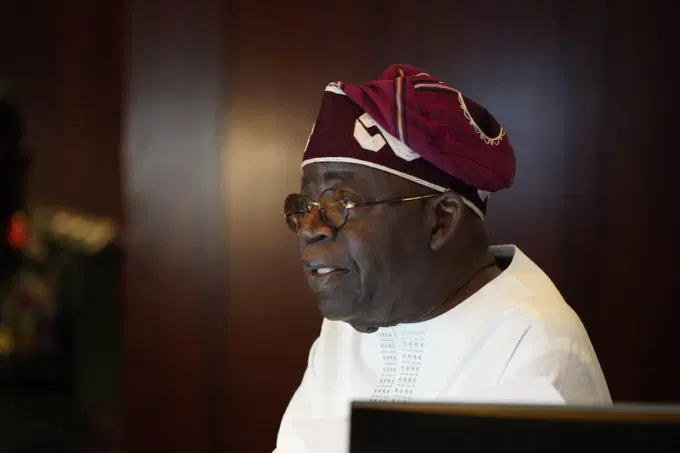
President Bola Ahmed Tinubu last night revisited the issue of fuel subsidy removal and once again foreclosed its return, saying the nation won’t go ‘back to Egypt’ on the matter.
Also, the Minister of Finance and Coordinating Minister of the Economy, Taiwo Oyedele, has warned that restoring fuel subsidy would devastate Nigeria’s economy, trigger capital flight, weaken the naira and ultimately impose a heavier burden on Nigerians through higher petrol prices.
But speaking at a special engagement tagged: “An Evening with the Original City Boy,” at the Conference hall of the State House, Abuja, the president likened the fuel subsidy removal to passages in both the Bible and the Quran.
“I remember my scripture studies, both in the Bible and in the Holy Quran. When Moses and Musa left Egypt, they faced a challenge, and the Red Sea parted and gave way. You cannot ask Moses to go back to Egypt,” he maintained.
He stressed that the decision to remove petrol subsidy on his first day in office was necessary to confront longstanding economic challenges, insisting that the country could not afford to reverse the reforms despite renewed promises by some political opponents to restore the subsidy regime.
“I removed the fuel subsidy on my first day in office. Nigeria will not go back to that era. I hear my political opponents promising a return to the subsidy regime, but Nigeria must win this election before any candidate does,” he said.
Tinubu declared that Nigeria would not reverse the economic reforms introduced since he assumed office in May 2023, despite the challenges associated with their implementation.
He defended his administration’s economic policies and reaffirmed his determination to build a more prosperous Nigeria.
The president recalled the economic difficulties inherited by his government, including what he described as excessive currency printing, fiscal pressures and structural weaknesses, explaining that his government had since embarked on reforms in taxation, monetary management and other critical sectors to reposition the economy.
He added: “Currency was being printed as if there was no tomorrow. That was a challenge, but rather than looking back, we took steps to address it and rebuild our tax system.”
Tinubu expressed satisfaction with the support of young Nigerians for his reform agenda, noting that despite predictions that the younger generation would reject the difficult policies, their continued engagement demonstrated confidence in the country’s future.
The president said the enthusiasm and commitment of members of the City Boy Movement reinforced his conviction that the sacrifices associated with the ongoing reforms would contribute to building a stronger nation.
“I did not see a crowd. I saw Nigeria,” Tinubu declared, explaining that the gathering reminded him of the reasons he sought the presidency and his daily commitment to national development.
He commended the movement for establishing extensive grassroots structures across states, local government areas and wards, describing its organisational approach, verifiable membership database, communication platforms and community engagement initiatives as an example of purposeful youth participation in national affairs.
Highlighting his administration’s youth-focused interventions, the president identified the Nigerian Education Loan Fund (NELFUND), which had supported more than one million students, as a significant initiative designed to ensure that financial limitations did not prevent young Nigerians from accessing higher education.
He also referenced the Nigerian Consumer Credit Corporation (CREDICORP), established to expand access to credit for workers seeking to acquire essential assets, including laptops, vehicles, motorcycles and solar energy systems.
Similarly, he highlighted the Three Million Technical Talent (3MTT) programme as part of the administration’s efforts to equip young Nigerians with globally competitive digital skills and opportunities to participate in the international technology economy.
Tinubu reaffirmed his commitment to appointing more qualified young Nigerians into positions of responsibility, maintaining that those who would inherit the consequences of today’s policy decisions deserved opportunities to participate in shaping them.
In a direct speech to his son and Patron of the City Boy Movement, Seyi Tinubu, the president urged him to deepen his commitment to public service, youth engagement and responsible leadership.
“My son, Seyi, you have only started. Do more. Go further. Serve harder. Set an example that your own children, my grandchildren, will be proud to follow. Nigerians are watching, and they should know that serving your country is the highest honour,” he said.
